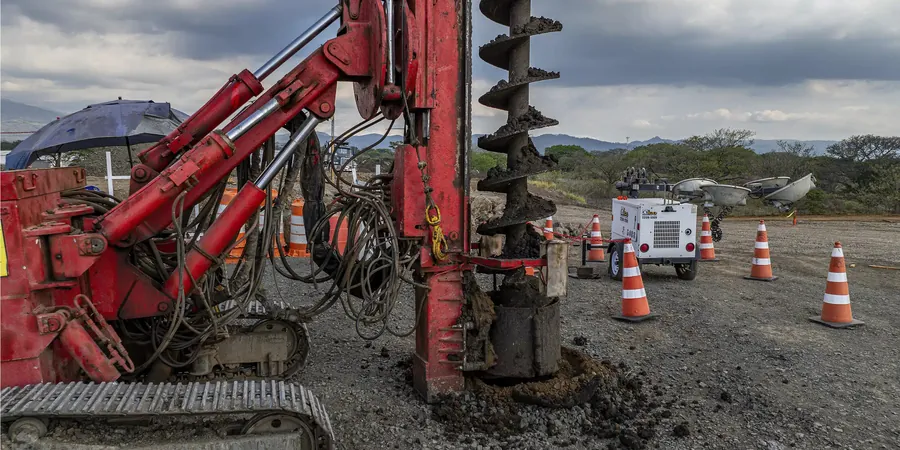
The vibroflot hangs from a crawler crane, its cylindrical body penetrating fill and marine silts at the bottom of a Porirua basin site. Stone column design starts here—with the rig’s ammeter telling us when the poker hits refusal on the greywacke basement, and with the volume of crushed basalt backfill disappearing into the ground. In Porirua, where the harbour edge and stream valleys concentrate soft alluvium over shallow bedrock, getting the column diameter, spacing, and modulus right determines whether a warehouse slab stays flat or a bridge approach embankment settles differentially. We run the CPT test to map undrained shear strength before selecting the vibro-replacement energy, and we cross-check against liquefaction susceptibility because much of the Porirua basin falls within high-seismicity zone classifications under NZS 1170.5.
A well-designed stone column is not a gravel pile; it’s a composite foundation element whose stiffness depends on confinement from the surrounding soil.
Approach and scope
Site-specific factors
On a five-storey apartment project near the Porirua Stream we reviewed columns that had been blindly spaced at 2.2 m centres across the entire footprint. The northern half of the site was underlain by estuarine mud with an undrained shear strength below 20 kPa, while the southern half sat on weathered greywacke at less than three metres depth. The uniform grid meant columns in the soft zone were overloaded, and differential settlement between the two halves of the building exceeded 40 mm before the frame was complete. Redesigning the layout with variable spacing and a reinforced load-transfer platform brought the angular distortion back within the 1/500 criterion acceptable for stiff cladding. In Porirua’s mixed profile geology, stone column design that ignores lateral variability creates exactly this type of post-construction problem—one that is far more expensive to fix than to prevent.
Relevant standards
NZGS Improvement Guidelines (2016), NZS 1170.5:2004 – Earthquake actions, NZS 4402 – Soil testing methods, Priebe H.J. (1995) – The design of vibro replacement, MBIE/NZGS Module 4 – Earthquake geotechnical engineering practice
Related technical services
Preliminary vibro-feasibility assessment
Review of available CPT and borehole logs to determine whether the fines content, depth to bedrock, and groundwater conditions in Porirua are compatible with vibro-replacement or whether a dry top-feed method is required.
Column geometry and grid design
Calculation of area replacement ratio, column length, and spacing using Priebe and unit-cell finite element models. We produce CAD layouts referenced to the structural grid and identify zones requiring variable spacing.
Load-transfer platform specification
Design of the granular mattress or geogrid-reinforced platform that bridges between column heads and distributes structural loads. Thickness is determined by arching theory and the allowable differential settlement for the superstructure.
Installation monitoring and acceptance testing
On-site supervision during vibroflot penetration and stone backfill, with real-time recording of depth, amperage, and aggregate consumption. Post-installation verification via CPT, zone load tests, or multi-channel surface wave testing.
Typical parameters
Questions and answers
What type of ground in Porirua is suitable for stone columns?
Stone columns work best in soft cohesive soils with undrained shear strength above 15 kPa, and in loose sands where vibro-replacement provides both densification and drainage. In Porirua the harbour-edge silts and alluvial clays are typical candidates. They are less effective in peat or very sensitive clays where radial confinement is insufficient, which is why we always run a CPT or vane shear profile before committing to the method.
How long does stone column installation take on a typical Porirua site?
A single vibroflot rig can install between 150 and 350 linear metres of column per shift, depending on depth and the resistance of the native soil. For a 1000-square-metre commercial pad in Porirua with columns to 8 metres depth, the installation phase typically takes four to seven working days, plus additional time for the load-transfer platform and verification testing.
What does stone column design and installation cost in Porirua?
For a medium-scale project in the Porirua area, the combined design, mobilisation, installation, and verification package usually falls between NZ$2,390 and NZ$8,040, with the final figure driven by column depth, area replacement ratio, and the accessibility of the site for the crawler crane and aggregate deliveries.
Can stone columns prevent liquefaction in Porirua’s seismic environment?
Yes, stone columns can serve as a liquefaction mitigation measure in granular soils by densifying the surrounding matrix and providing vertical drainage to dissipate excess pore pressure during shaking. In Porirua’s high-seismicity setting the design must meet the performance criteria of MBIE/NZGS Module 4, and we typically verify the improved state with post-installation CPT testing correlated to the revised factor of safety against liquefaction.