NZS 3404 and the NZGS guidelines frame every slope stability analysis in Porirua, where the terrain shifts from coastal platforms to steep greywacke hills. The city sits across the Kenepuru fault system, and weathered bedrock grading into colluvium defines much of the eastern suburbs. We combine limit-equilibrium modelling with borehole-derived strength parameters to assess circular and planar failure mechanisms. For deeper investigation in the Whitby and Aotea developments, sondajes SPT deliver penetration resistance logs that feed directly into the stability model. A single desktop review without site-specific shear strength data misses the variability that Porirua’s residual soils present after heavy winter rainfall.
A slope stability analysis without site-specific residual shear strength misses the failure mechanism that activates most Porirua earthworks after wet winters.
Approach and scope
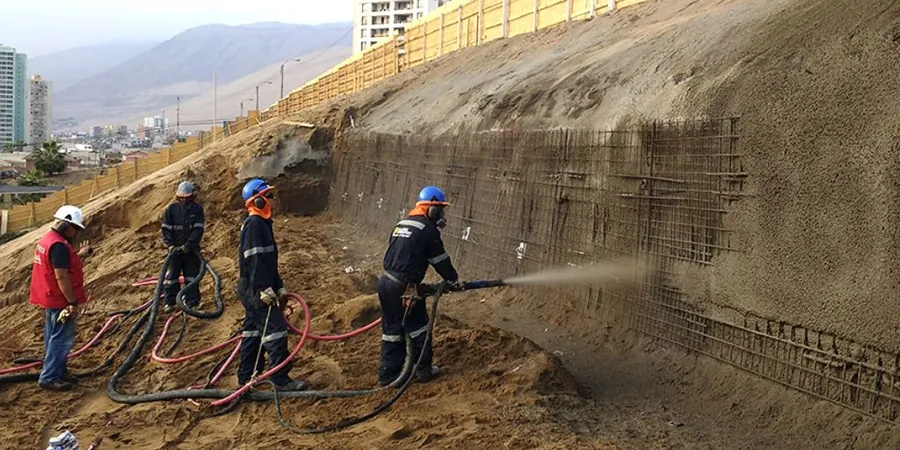
Site-specific factors
Porirua City has over 60,000 residents and a housing stock expanding into steeper terrain north of the city centre. The 2016 Kaikoura earthquake reminded the region that moderate-magnitude events can trigger landsliding in cut-and-fill earthworks. Skipping a site-specific analysis means accepting a residual risk that insurers and councils increasingly question during consenting. A slope failure on a residential lot can undermine foundations, sever drainage and expose owners to liability under the Building Act. The analysis quantifies the margin of safety and identifies whether benching, drainage or retaining structures are needed before earthworks begin.
Service video
Relevant standards
NZS 3404:1997 (Steel structures – embedded retaining reference), NZS 1170.5:2004 (Seismic actions), NZGS Guidelines for Slope Stability Assessment, MBIE B1/VM1 and B1/AS1 (Stability of land)
Related technical services
Residential and subdivision slope assessment
Desktop review, field mapping, hand-auger and machine borehole logging, laboratory shear box or ring shear tests, and limit-equilibrium modelling for cut and fill batters on sites across Elsdon, Titahi Bay and Whitby.
Remediation design and peer review
Back-analysis of existing slips, pore-pressure monitoring with standpipe piezometers, and design of drainage measures, soil nails or retaining walls to achieve the required factor of safety under drained and seismic conditions.
Typical parameters
Questions and answers
How long does a slope stability analysis take in Porirua?
A straightforward residential assessment with a single borehole and laboratory testing typically takes three to four weeks from site work to draft report. Complex subdivision projects with multiple cross-sections and piezometer monitoring can extend to six or eight weeks, depending on weather and lab scheduling.
What is the approximate cost range for a slope stability analysis?
Costs in Porirua generally range from NZ$2,190 for a simple desktop review of a small cut face to NZ$6,030 for a full investigation with boreholes, laboratory shear strength testing and a detailed design report for council consent.
Do councils in the Wellington region require a slope stability report?
Yes. Porirua City Council and Greater Wellington Regional Council routinely request a slope stability assessment as part of resource consent for earthworks on slopes steeper than 15 degrees, or where fill exceeds 1.5 metres in height, following the NZGS guidelines and the Building Code clause B1.
Can you analyse an existing slip and design a repair?
We carry out back-analysis of existing failures to calibrate soil strength parameters, then model the repaired profile with drainage, regrading or retaining elements to meet the required factor of safety for the design life of the structure.