Porirua’s transport network has grown steadily since the 1960s, driven by the expansion of suburbs like Whitby and Aotea on hillsides and reclaimed gullies. We have seen firsthand how variable the fill materials can be across the city, from weathered greywacke to clay-rich colluvium. That variability makes a reliable laboratory CBR test indispensable before placing any pavement structure. Our lab in the region runs soaked CBR tests under NZS 4402:1988, giving engineers a clear picture of subgrade bearing capacity after saturation. Results typically align with the local NZTA M/4 specification thresholds, and we often pair the CBR data with Proctor compaction to confirm maximum dry density and optimum moisture content before site compaction starts.
A four-day soaked CBR on a remoulded Porirua silt can drop from 12% to 4% — that single value changes the pavement thickness by over 100 mm.
Approach and scope
Site-specific factors
Much of Porirua’s low-lying land sits on Holocene alluvium and estuarine deposits that can hold groundwater within 1.5 metres of the surface in winter. Under those conditions, an unsoaked CBR gives a false sense of security. We have reviewed pavement failures in the Kenepuru area where rutting appeared within two years because the design assumed a CBR of 8% while the soaked value was closer to 2.5%. The NZ Transport Agency’s supplement to Austroads requires soaked CBR for all new arterial roads, and ignoring that requirement can lead to costly basecourse replacement. If the subgrade contains volcanic ash lenses, common near the Tītahi Bay fossil forest, the swell potential can be significant and must be captured during the four-day soak.
Relevant standards
NZS 4402:1988 Test 3.1.1, NZTA M/4 specification, Austroads Guide to Pavement Technology Part 2
Related technical services
Soaked CBR with compaction curve
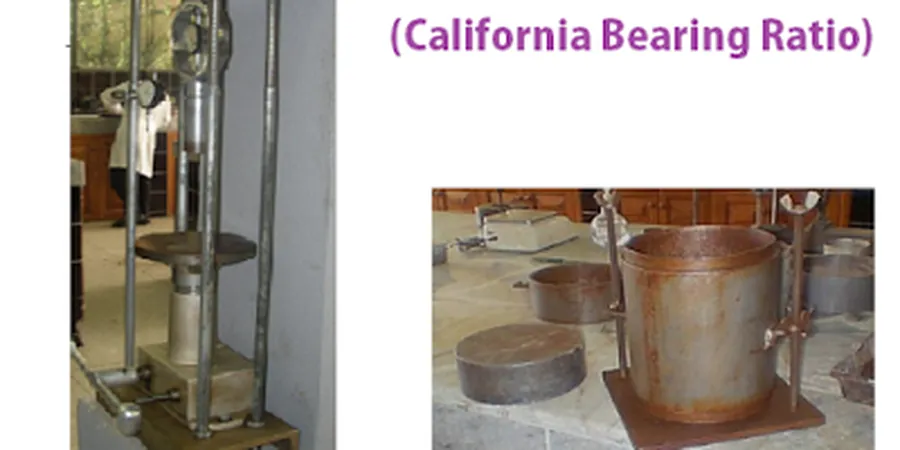
We run the standard four-day soaked CBR on three remoulded specimens, combining it with the New Zealand vibrating hammer compaction test to define the moisture-density relationship. The report includes load-penetration curves, CBR at 2.5 mm and 5.0 mm, initial and final moisture content, and swell percentage.
CBR on undisturbed tube samples
For critical sites where remoulding may overestimate the in-situ strength, we test undisturbed Shelby tube samples. This approach is valuable in Porirua’s stiff residual clays, where the natural structure contributes to bearing capacity that a remoulded test would miss.
Typical parameters
Questions and answers
How much does a laboratory CBR test cost in Porirua?
A standard soaked CBR on three remoulded points, including the compaction curve and swell measurement, ranges from NZ$230 to NZ$300. The final figure depends on the number of specimens and whether we need to run additional one-point CBRs for a family of moisture contents.
What sample mass do I need to send for a remoulded CBR?
We need about 25 kg of representative subgrade material, bagged and sealed to preserve field moisture. If the sample will travel from a site in Porirua’s eastern hills, we recommend collecting it in two heavy-duty plastic bags to prevent drying during transport.
How long does the soaked CBR test take in your lab?
The full sequence — compaction, four-day soaking, and penetration — takes four to five working days from the day we receive the sample. We can expedite reporting if the project programme requires it, but the four-day soak period is fixed by the standard.
Can you test stabilised subgrade with the CBR method?
Yes, we test cement- or lime-stabilised specimens after the specified curing period, normally seven days. For Porirua’s silty clays, a 3% cement addition often lifts the soaked CBR above 15%, and we report both the immediate and cured values so the designer can check the gain over time.