A recent residential subdivision in the Aotea block encountered fill material that varied drastically from one lot to the next — greywacke-derived clay in one corner, weathered siltstone just fifty metres away. The site supervisor needed a reliable baseline for compaction before a single layer of structural fill went down. That baseline comes from the Proctor test, which establishes the relationship between moisture content and dry density for a specific soil. Without it, field density readings from a nuclear gauge or sand-cone test become guesswork. The lab team ran both Standard and Modified Proctor compactions on samples taken from each cut area, giving the earthworks contractor target values that matched the material actually being placed. In a city where the footings for new builds must contend with everything from Pleistocene alluvium to weathered greywacke, having a curve generated from your own site soil is the only defensible starting point for compaction acceptance.
A Proctor curve built from your own site soil removes the single largest source of error in field density acceptance — using a generic reference value instead of the material actually under the roller.
Approach and scope
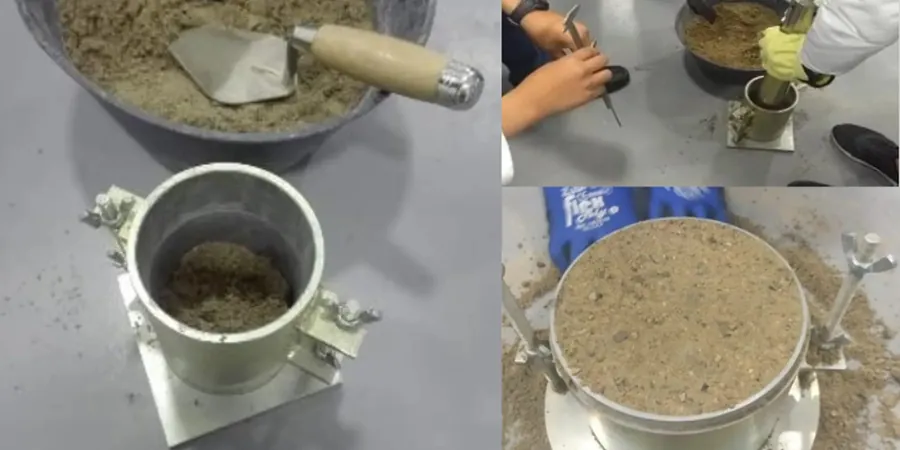
Site-specific factors
NZS 4431:1989 sets the framework for earthworks control in New Zealand, and in Porirua the consequences of skipping a proper Proctor determination are magnified by the city's exposure to long-return-period seismic shaking and heavy southerly rainfall events. A fill placed too dry — below the OMC window — will not knit together under compaction and can settle differentially after the first wet winter, cracking floor slabs and driveways. Material compacted wet of optimum on the harbour side of the isthmus often traps pore pressure that bleeds out slowly, leaving a structure founded on a fill that is still consolidating years after practical completion. The Modified Proctor test becomes essential when the specification calls for high-energy compaction of sub-base aggregate or when dealing with gravelly fills typical of the alluvial fans that spread into Porirua Harbour from the Horokiri and Pauatahanui catchments. An IANZ-accredited Proctor report provides the defensible documentation that engineers, council inspectors, and geotechnical reviewers expect when sign-off is contingent on demonstrated fill performance.
Service video
Relevant standards
NZS 4402:1986 — Methods of testing soils for civil engineering purposes (Tests 4.1 and 4.2), NZS 4431:1989 — Code of practice for earth fill for residential development, NZS 4407:2015 — Methods of sampling and testing road aggregates (compaction control reference), ISO/IEC 17025 — General requirements for the competence of testing and calibration laboratories (IANZ accreditation)
Related technical services
Atterberg Limits and Particle Size Distribution
Liquid limit, plastic limit, and plasticity index testing per NZS 4402:1986, combined with wet sieving and hydrometer analysis, classify the fill material and explain why the Proctor curve has a sharp or flat peak — highly plastic clays produce narrow OMC windows that demand tight field moisture control.
Field Density Correlation (Sand Cone or Nuclear Gauge)
The Proctor maximum dry density is the laboratory reference value used to calculate relative compaction from field density tests. We work directly with site technicians running NZS 4402 Test 5.1 sand replacement or nuclear gauge measurements, ensuring the same material standard is applied from the lab bench to the lift being compacted.
Typical parameters
Questions and answers
When should the Modified Proctor test be specified instead of the Standard Proctor for a Porirua subdivision?
Modified Proctor (NZS 4402 Test 4.2) is appropriate when the earthworks specification requires a higher compactive effort — typically for structural fill under building platforms, road sub-base aggregate, or heavily trafficked pavement layers. In Porirua subdivisions on sloping sites such as Whitby or Aotea, where cut-to-fill transitions must minimise long-term settlement, the Modified effort provides a density target that better reflects the compactive energy of modern 12-tonne vibratory rollers. Standard Proctor (Test 4.1) remains adequate for landscape fill, trench backfill in non-structural zones, and low-density residential lots on flat terrain. The decision ultimately rests with the project's geotechnical engineer, who considers the fill material type, the consequence of settlement, and the specified relative compaction percentage.
How much does a Proctor compaction test cost in the Wellington-Porirua region?
A Standard Proctor test (NZS 4402 Test 4.1) on a single bulk sample typically runs between NZ$160 and NZ$260, while a Modified Proctor (Test 4.2) ranges from NZ$240 to NZ$360 due to the additional compaction effort and material handling. The final price depends on whether the sample requires pre-treatment such as drying, particle size reduction to pass the 19 mm or 37.5 mm sieve, and whether one-point rapid checks or full five-point curves are requested. Multi-sample projects — common when a subdivision has several cut areas with different soil types — attract reduced per-sample rates. All testing is performed under IANZ accreditation, and the report includes the plotted compaction curve with zero-air-voids line and tabulated density targets at 95% and 98% of MDD.
What soil sample mass is needed for a Proctor test, and how should it be transported to the lab?
A minimum of 25 kg of representative disturbed soil is required for a full Standard or Modified Proctor test when using the 4-inch mould. If the material contains particles larger than 19 mm and a 6-inch mould is necessary, the required mass increases to approximately 45 kg. The sample should be sealed in heavy-duty plastic bags immediately after excavation to prevent moisture loss, placed inside a sturdy bucket or sample crate, and delivered to the laboratory within 24 hours whenever possible. For Porirua sites where the fill material changes over short distances — a common scenario in the weathered greywacke terrain — separate bagged samples labelled with the cut location and target compaction specification help the lab assign the correct test method from the outset.