A retaining wall design in Porirua starts with a Schmidt hammer and a hand auger. The coastal terraces and steep greywacke hillsides that define this city of 60,000 demand a physical understanding of the ground before any structural calculations begin. We log the cut face, measure joint spacing in the weathered rock, and collect bag samples of the residual silts that mantle the slopes around Whitby and Aotea. These observations feed directly into the slope stability analysis that underpins any gravity or cantilever wall configuration. Porirua’s geology shifts within a single section: colluvium over weathered greywacke, then fresh rock at depth. Our team runs point load tests on core fragments to estimate UCS, while the Atterberg limits on the overlying soils tell us how much the material will swell after a wet winter. That combination of rock mechanics and soil behaviour shapes the earth pressure diagrams we deliver.
A retaining wall in Porirua must handle two loads: the soil mass behind it and the pore pressure that builds when the greywacke contact acts as a subsurface dam.
Approach and scope
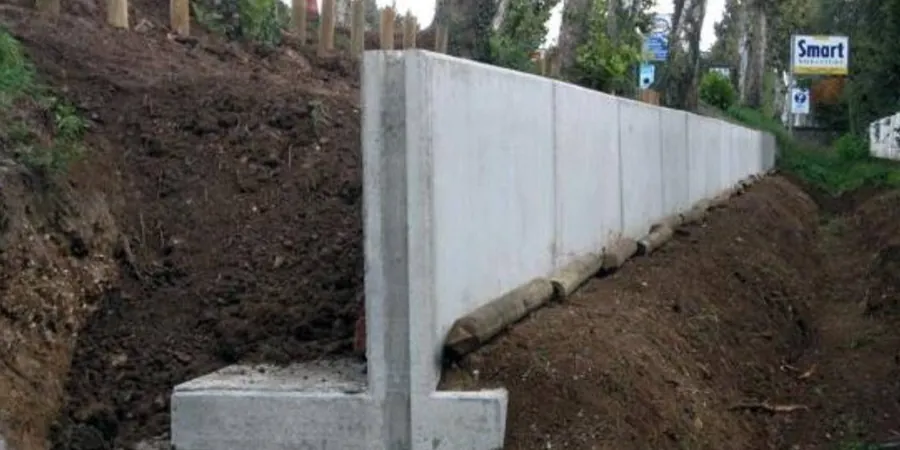
Site-specific factors
At 41.1° south, Porirua sits within 15 km of the Ohariu Fault, a major dextral strike-slip structure with a recurrence interval of roughly 1,000–3,000 years. The 1855 Wairarapa earthquake (M8.2) produced Modified Mercalli intensities of VIII–IX across the region, and a comparable event would impose lateral spreading demands on any retaining structure founded in reclamation fill. The CBD area along the harbour edge and sections of Titahi Bay Road are underlain by Holocene marine sediments that amplify ground motion. A wall designed only for static loading in these zones faces a real risk of rotational failure during a design-level earthquake. Our analysis incorporates the NZGS seismic design guidelines, applying a Mononobe-Okabe pseudo-static increment to the active wedge. For walls over 3.0 m retained height, we also check the potential for liquefaction of the foundation soil using SPT-based triggering correlations, as the loose sands in the Porirua stream alluvium have shown N-values below 10 in previous investigations. Where the factor of safety against bearing failure drops below 1.2 under seismic load, we specify a stone-columns Improvement program before wall construction.
Service video
Relevant standards
NZS 3404:1997 – Steel Structures Standard (retaining wall section), NZS 1170.5:2004 – Structural Design Actions – Earthquake Actions, NZGS (2016) – Earthquake Geotechnical Engineering Practice, Module 6: Retaining Walls, NZS 4404:2010 – Land Development and Subdivision Infrastructure (drainage filters)
Related technical services
Site investigation and logging
Drilling and test pit excavation at the wall alignment to log greywacke weathering grades, joint orientations, and fill thickness. We measure RQD and fracture spacing for rock socket design.
Laboratory strength testing
Direct shear tests on backfill and foundation soils to determine φ' and c' at the expected field density. Triaxial CIU tests for clay-rich residual soils where undrained loading may govern short-term stability.
Earth pressure and stability calculations
Coulomb and log-spiral analyses for gravity and reinforced concrete cantilever walls. Seismic increment per Mononobe-Okabe with site-specific PGA from the NZ Seismic Hazard Model.
Drainage and filter design
Permeability testing of backfill and foundation materials, followed by filter gradation specification using Terzaghi and USBR criteria. Design of toe drains, weep holes, and blanket drains for the Porirua rainfall regime.
Typical parameters
Questions and answers
What is the typical cost range for retaining wall design in Porirua?
Retaining wall design fees in Porirua generally range from NZ$1.540 to NZ$6.240 depending on retained height, site access, and whether rock sockets or Improvement are required. A simple gravity wall under 1.5 m might fall at the lower end, while a reinforced cantilever wall over 3.0 m with seismic analysis and drainage design typically sits in the upper portion of that range.
What seismic provisions apply to retaining walls in the Wellington region?
NZS 1170.5 defines the seismic hazard; for Porirua, the design PGA ranges from 0.4g to 0.6g on rock, amplified by site class. We apply the Mononobe-Okabe pseudo-static method with a horizontal coefficient kh of 0.20 to 0.30 depending on wall type and allowable displacement, following the NZGS Module 6 recommendations for the Wellington area.
How do you handle groundwater behind a retaining wall in Porirua's hillside subdivisions?
We first measure the in-situ permeability of the retained soil and identify any perched water tables. The drainage system is then designed to lower the phreatic surface below the wall base. This typically involves a geotextile-wrapped gravel drain 300 mm wide, with a perforated collector pipe discharging to a stormwater system. The filter gradation is checked against the backfill grain-size curve to prevent clogging.
Can you design retaining walls on the fill that covers many older Porirua sections?
Yes, but it requires careful investigation. Uncontrolled fill from the mid-20th century can contain building rubble, variable compaction, and perched water. We excavate test pits to log the fill profile, run density and strength tests on undisturbed samples where possible, and often specify a deeper foundation level—either keying into the natural greywacke or using a Improvement technique like stone columns to reduce differential settlement under seismic load.