Porirua's development from a small railway settlement into a city of over 60,000 people brought construction onto terrain that tests any ground engineering strategy. The harbour-fringed basin, carved by the Porirua Fault, combines greywacke hill slopes, deep alluvial silts in the Tawa and Porirua East flats, and weathered terrace gravels in Whitby and Aotea. When cut-and-cover excavations or permanent retaining walls are required in these materials, passive resistance alone is rarely sufficient. Our anchor design work addresses exactly that gap: selecting between active prestressed anchors and passive ground anchors based on allowable deformation, load magnitude, and the stiffness contrast between greywacke and soft estuarine deposits. For projects where the excavation sequence demands continuous load monitoring, the approach often integrates excavation monitoring to validate lock-off loads against the design assumptions.
Anchored systems in Porirua must reconcile high seismic demand from the Wellington Fault zone with bond stresses that can drop below 50 kPa in estuarine silts.
Approach and scope
Site-specific factors
A repeated mistake on Porirua construction sites is specifying anchor free lengths based on assumed failure wedges without verifying the actual soil-to-rock interface depth. On a commercial excavation along Lyttelton Avenue, a contractor installed strand anchors with free lengths terminating in weathered greywacke rather than passing into unweathered rock; load testing revealed excessive creep under proof load, requiring de-tensioning, re-drilling and re-grouting at significant programme cost. Another classic error involves applying active anchor lock-off loads without accounting for short-term relaxation in the Waitangirua loess-derived silts. Even a 2% relaxation across 30 anchors can redistribute enough load to crack a shotcrete facing before the permanent wall drain is commissioned. These failures are preventable with a geotechnical baseline that maps the weathering profile and porewater regime before anchor design commences.
Relevant standards
NZS 3404:1997 – Steel Structures Standard (anchor components, testing), NZS 1170.5:2004 – Structural Design Actions – Earthquake Actions, NZGS Ground Anchor Guidelines (2016), BS 8081:2015 – Code of practice for grouted anchors, EN 1537:2013 – Execution of special geotechnical work – Ground anchors
Related technical services
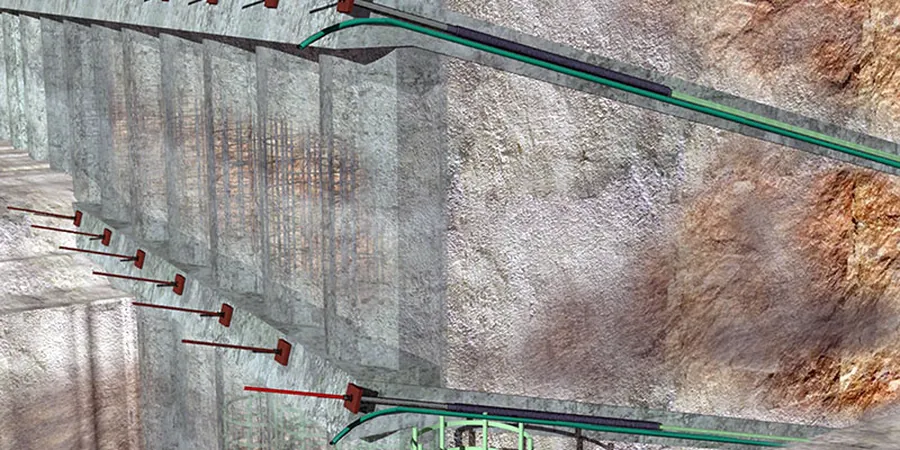
Temporary excavation tiebacks
Active strand anchors for soldier pile and shotcrete walls in Porirua's commercial and infrastructure cuts, with staged testing per NZS 3404 and lock-off procedures calibrated to the soil relaxation characteristics of the local geology.
Permanent retaining wall anchors
Double-corrosion-protection passive and active anchors for MSE walls, diaphragm walls and bored pile walls along Porirua's harbour-edge and hillside developments, designed for 100-year service life with full encapsulation detail.
Anchor load testing and verification
On-site suitability tests, proof tests and extended creep tests on sacrificial anchors to validate bond stress assumptions before production drilling begins, particularly in the variable colluvium-greywacke transition zones found across the Porirua basin.
Typical parameters
Questions and answers
What is the difference between active and passive anchors in terms of load application?
Active anchors are prestressed after installation and locked off at a defined load, typically between 60% and 80% of the design working load, so they actively compress the retained soil mass from the start. Passive anchors develop resistance only as the ground deforms; they are not prestressed and rely on movement of the structure to mobilise the design force. In Porirua, we specify active anchors where wall deflection must be kept below 10 mm — common in urban excavations — and passive anchors where some controlled displacement is acceptable, such as in cut slopes in the Whitby hills.
How much does anchor design and testing cost for a retaining wall in Porirua?
The combined cost for anchor design, suitability testing and production anchor proof testing for a typical Porirua retaining wall project falls between NZ$1,680 and NZ$6,020, depending on the number of anchors, the access conditions on site, and whether permanent corrosion protection details are required. Suitability tests on sacrificial anchors before production drilling are a separate line item but are essential for validating bond stress assumptions in the variable greywacke and alluvial profiles across the city.
Are there specific seismic provisions for anchor design in the Porirua area?
Yes, Porirua lies within a high-seismicity zone with near-source factors applicable under NZS 1170.5. Anchor design must account for the additional seismic earth pressures on the retained structure, as well as the potential degradation of bond stress during cyclic loading. NZGS guidelines recommend that the anchor bond length be located beyond any seismically induced failure surface, and that proof testing includes a creep assessment to ensure the anchor can sustain load without excessive relaxation during and after a design-level earthquake.