The Benkelman beam still sees regular use on Porirua project sites, particularly where reclaimed land meets the hills. It is a simple tool, but when calibrated against local deflection data, it provides a direct measure of pavement response under wheel load. Our team deploys it alongside dynamic cone penetrometer rigs to correlate surface deflection with subgrade strength. In Porirua, where the terrain shifts from estuarine silts in the harbour basin to weathered greywacke on the slopes, understanding that relationship is what separates a pavement that lasts 25 years from one that shows fatigue cracking in five. The CBR road testing protocol we follow is adapted to these transitions, ensuring the design modulus reflects actual in-situ conditions rather than generic assumptions. For deeper profiling where soft layers are suspected beneath the pavement crust, we integrate in-situ permeability measurements to anticipate drainage behavior and moisture-related strength loss.
A pavement is only as strong as the subgrade it rests on — in Porirua's mixed terrain, that means designing for the weakest metre, not the average.
Approach and scope
Site-specific factors
The nor'westerly exposure on Porirua's coastal edges introduces a moisture cycling risk that inland pavements never face. Salt-laden spray combined with heavy rainfall events — Porirua averages over 1,200 mm annually — accelerates stripping in bituminous layers if the aggregate-bitumen bond is marginal. Meanwhile, the shaded valleys that run up toward Kenepuru hold moisture long after the ridges have dried, creating subgrade softening that is highly seasonal. Our pavement designs account for this by specifying moisture-resistant aggregate blends and, where necessary, lime or cement stabilisation of the upper subgrade to a depth of 200–300 mm. Another factor specific to the Porirua basin is the seismic settlement potential in saturated silts. A pavement may survive the earthquake structurally, but differential settlement across a road alignment can render it unserviceable. We address this through subgrade densification or geogrid reinforcement where liquefaction assessments indicate excessive post-seismic deformation.
Relevant standards
NZS 3404:2009 — Steel structures (design provisions), NZS 4404:2010 — Land development and subdivision infrastructure, Austroads Guide to Pavement Technology Parts 1–5, NZTA M/4 Specification for basecourse aggregate, AS 3705:2012 — Geotextiles for separation and filtration
Related technical services
Pavement structural design
Mechanistic-empirical design of granular pavements with bituminous surfacing, using local subgrade CBR and aggregate resilient modulus inputs. We produce design reports compliant with Porirua City Council standards and NZTA requirements for arterial and local roads.
Subgrade investigation and improvement
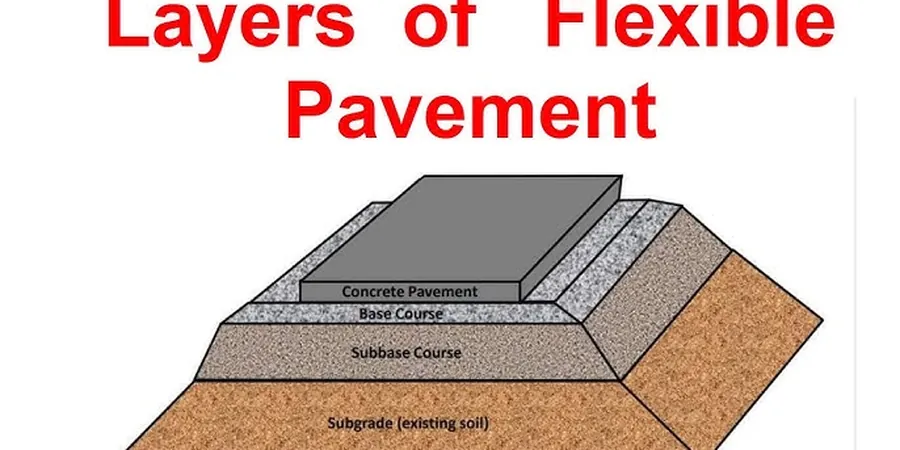
Field CBR testing, DCP profiling, and laboratory classification of subgrade soils. Where soft or expansive soils are encountered, we design lime/cement stabilisation or geotextile separation layers to achieve the target support condition.
Deflection testing and rehabilitation
Benkelman beam or FWD deflection surveys on existing pavements to determine residual life and overlay requirements. We correlate deflection data with subgrade strength to design rehabilitation treatments that extend pavement life at minimum cost.
Construction monitoring and QA
Field density testing using nuclear gauge and sand replacement, aggregate quality verification against M/4 specification, and layer-by-layer compaction control. We deliver practical feedback to contractors during placement to keep the work on track.
Typical parameters
Questions and answers
What is the typical cost range for flexible pavement design on a residential subdivision in Porirua?
For a standard residential subdivision road design in Porirua, including subgrade investigation, pavement design, and construction specification, fees generally range from NZ$2,880 to NZ$7,540 depending on the number of lots, terrain complexity, and whether rehabilitation of an existing track is involved. A site-specific quote is always provided after an initial walkover.
How does the Porirua harbour environment affect pavement performance?
The combination of saline air, high rainfall, and soft estuarine soils near the harbour creates three main challenges: moisture sensitivity in basecourse aggregates, reduced subgrade bearing capacity during wet months, and potential for salt-induced stripping in bituminous seals. Our designs address these through drainage detailing, subgrade stabilisation, and specifying aggregates with proven moisture resistance.
What subgrade strength is required before placing the pavement layers?
We typically target a field CBR of at least 5% for the upper 300 mm of subgrade under flexible pavements in Porirua. Where natural soils fall below this — common in the alluvial flats near the city centre — we specify lime or cement stabilisation, or a geotextile separation layer with imported fill, to bring the support condition up to the design value.