Porirua’s construction boom isn’t slowing down. With over 60,000 residents and major subdivisions pushing into the hills behind Whitby, Aotea, and Kenepuru, every new building pad and roadway sits on cut-and-fill that must be verified. The weathered greywacke and windblown loess common across the Porirua basin compact unevenly. That’s where the sand cone density test becomes non-negotiable. NZS 4402:1988 specifies the method. Our IANZ-accredited lab runs it weekly across Porirua sites. The sand cone test measures in-place dry density directly. No extrapolations. No assumptions. Just a physical measurement that ties back to your Proctor curve. When Council asks for compaction records, you need data that holds up.
Porirua’s seismic profile adds another layer. The city sits within 30 km of the Wellington Fault, and NZS 1170.5 classifies much of the area as Site Class C or D. Loose fill on a hillside subdivision behaves very differently during a tremor than properly compacted material. A Proctor curve calibrated to the specific borrow source gives you the maximum dry density reference that makes the sand cone result meaningful. Without that pairing, a density reading is just a number.
The sand cone test gives you a physical density measurement you can verify with a scale and a calculator — no black-box algorithms.
Approach and scope
What makes the sand cone test so practical for Porirua earthworks is its tolerance for site conditions. Wind, light rain, tight access between services, sloping subgrade, variable aggregate size—none of it stops the test. The technician excavates a small hole, weighs the extracted soil, fills the void with calibrated sand, and calculates the in-place density on site. The method works on granular roading aggregate as easily as on clayey silt fill. Compare that to a nuclear gauge, which requires a separate trench for the probe and a radiation safety plan. The sand cone doesn’t need a license to transport. It doesn’t need daily standardization against a block. It just works.
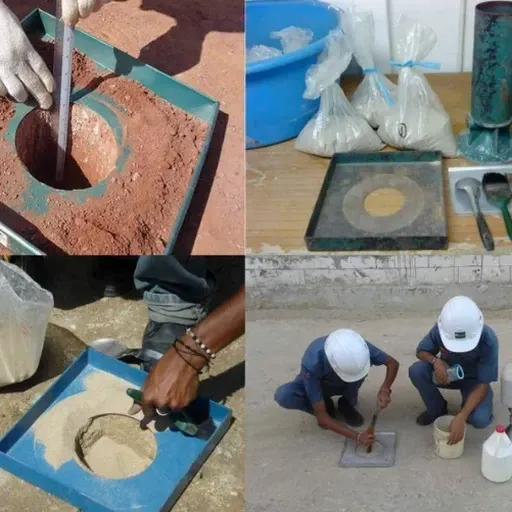
Site-specific factors
Porirua build-ups on hillside fills carry a risk that isn’t visible from the surface. The fill might look solid after a few passes with a smooth-drum roller, but density testing reveals what the eye misses. We’ve seen test pits in Aotea where the top 150 mm hit 98% compaction and the layer beneath fell to 88%. The contractor had been compacting thin lifts but forgot to scarify between them. A density gauge on the surface wouldn’t have caught it. The sand cone test, with its excavated hole, measures through the full lift.
Another Porirua-specific hazard is moisture sensitivity in loess-derived fill. When compaction happens at the wrong moisture content—even by 2%—the dry density can drop dramatically. The sand cone result flags this immediately because the lab moisture content gets determined from the same excavated material. No separate sampling step. No delay. You know before the next truckload arrives whether the fill is going in properly. That real-time feedback saves rework costs that routinely hit five figures on subdivision-scale earthworks.
Service video
Relevant standards
NZS 4402:1988 Test 5.1 (Sand cone method), NZS 4402:1988 Test 4.1.3 (Modified Proctor compaction), NZS 4431:1989 (Engineered fill construction), NZS 1170.5:2004 (Seismic loading — site subsoil class)
Related technical services
Field Density Testing (Sand Cone)
In-place density measurement to NZS 4402 Test 5.1. Includes moisture content determination, compaction percentage calculation, and a signed test report accepted by Porirua City Council.
Laboratory Proctor Compaction
Standard and modified Proctor curves to NZS 4402 Test 4.1.3, run on your specific borrow material. The reference density that gives the field test its meaning.
Earthworks QA and Inspection
On-site supervision and testing schedule management for subdivision fills, building platforms, and road subgrade. IANZ-accredited reporting that streamlines Council sign-off.
Typical parameters
Questions and answers
What does a sand cone density test cost in Porirua?
A single sand cone density test in Porirua typically runs between NZ$180 and NZ$210, depending on site access and the number of tests scheduled per visit. Most earthworks jobs require multiple tests per day, and we structure pricing to reward volume rather than charging a flat per-test rate.
How many sand cone tests do I need for my subdivision fill in Porirua?
NZ standards don’t prescribe an exact number—it depends on the fill volume, lift thickness, and the variability of the material. A typical Porirua residential subdivision tests one location per 300 m³ of placed fill, with at least one test per lift per 500 m² of area. Council engineering approval conditions usually specify the minimum frequency.
Can the sand cone method be used on coarse gravel or hardfill?
Yes, with limits. NZS 4402 Table 5.1 specifies the minimum test hole volume based on the maximum particle size. For material with particles larger than about 40 mm, the required hole becomes impractically large and a replacement method—such as a water replacement test—may be more appropriate. Our technician will assess the material on site and recommend the right approach.