Ground conditions around the Porirua basin can shift dramatically within a single site. The flat land near the city centre, sitting on reworked alluvium and soft sediments from the Porirua Stream, behaves very differently from the weathered greywacke slopes climbing toward Whitby or Aotea. In our track record, this contrast catches out designers who rely on scattered borehole data alone. A Cone Penetration Test run across both zones maps the transition precisely, giving you a continuous profile of tip resistance and sleeve friction rather than isolated samples. For sites near the harbour edge, where tidal muds and loose sands interlayer, we often complement the CPT with liquefaction assessment using the Robertson method to determine cyclic resistance ratios directly from the cone data. Porirua sits in a high seismic zone, and the NZGS guidelines make it clear: effective stress analysis starts with clean, uninterrupted cone readings that capture thin layers a standard sampler would miss.
A continuous CPT profile captures thin liquefiable layers that a split-spoon sampler would completely miss, and that changes the seismic design outcome for Porirua sites.
Approach and scope
Site-specific factors
A mid-rise apartment project off Warspite Avenue came to us after preliminary boreholes suggested competent gravels at 6 metres. The architect planned shallow pad footings, but the site sat on a buried stream channel visible only in old aerial photos. We ran three CPT soundings across the footprint and found a 2-metre lens of very loose silty sand at 4.5 metres that the boreholes had entirely missed. The cone resistance dropped below 2 MPa in that band, triggering a liquefaction flag for the design earthquake. Catching it before construction meant the structural engineer could switch to a pile foundation solution socketed into the dense gravel beneath, avoiding a costly post-construction retrofit. Porirua's alluvial valleys hide paleochannels like this one, and discontinuous sampling simply does not deliver the vertical resolution needed to detect them. The cost of a CPT program is negligible compared to the liability of a foundation settlement or lateral spread failure discovered after the building is occupied.
Relevant standards
NZS 4402: Standard Test Method for Electronic Friction Cone and Piezocone Penetration Testing of Soils, NZS 1170.5:2004 Structural design actions – Earthquake actions – New Zealand, NZGS Guidelines for Liquefaction Assessment (2016) and Module 4: CPT-based methods, Boulanger & Idriss (2014) CPT and SPT based liquefaction triggering procedures
Related technical services
Seismic CPTu with Liquefaction Screening
Piezocone soundings with pore pressure dissipation tests at critical depths, processed through the Boulanger-Idriss framework to deliver cyclic resistance ratios, factor of safety against liquefaction, and post-liquefaction settlement estimates for NZS 1170.5 compliance.
Foundation Parameter Profiling for Shallow and Deep Design
Direct correlation of cone resistance to undrained shear strength, constrained modulus, and friction angle using regionally calibrated coefficients for Porirua's alluvial and residual soils, feeding directly into bearing capacity calculations and pile shaft friction estimates.
Typical parameters
Questions and answers
What does a CPT cost for a typical residential section in Porirua?
For a standard residential lot in Porirua, a single CPT sounding to 15–20 metres depth typically falls between NZ$320 and NZ$360 per sounding, though the total project cost depends on how many push locations are needed, access conditions, and whether pore pressure dissipation tests are included. Steep sections requiring tracked equipment or sites with very dense gravels that need pre-drilling can push costs higher. We deliver a fixed-price quote after reviewing the site plan and any existing geotechnical data.
How deep can the CPT push in Porirua's greywacke soils?
Cone refusal occurs when the tip resistance consistently exceeds 50 MPa, which typically happens at the top of moderately weathered greywacke or within dense gravel layers. In the Porirua basin, refusal depths range from 8 metres in hillside colluvium to over 25 metres in the deeper alluvial channels near the harbour. Once refusal is reached, we record the depth and can coordinate with a drilling crew to advance a borehole through the rock socket if required for pile design.
Can CPT data be used directly for foundation design?
Yes, and this is one of the main reasons engineers specify CPT in Porirua. Cone tip resistance correlates directly to bearing capacity for shallow footings via methods like Schmertmann and to unit shaft friction for piles via the LCPC or ICP design approaches. The continuous profile lets you identify the optimal founding depth without conservatively assuming the worst layer governs. We deliver processed data in formats compatible with CPeT-IT and other geotechnical software so your designer can import and model immediately.
How long does a CPT take and what access is needed?
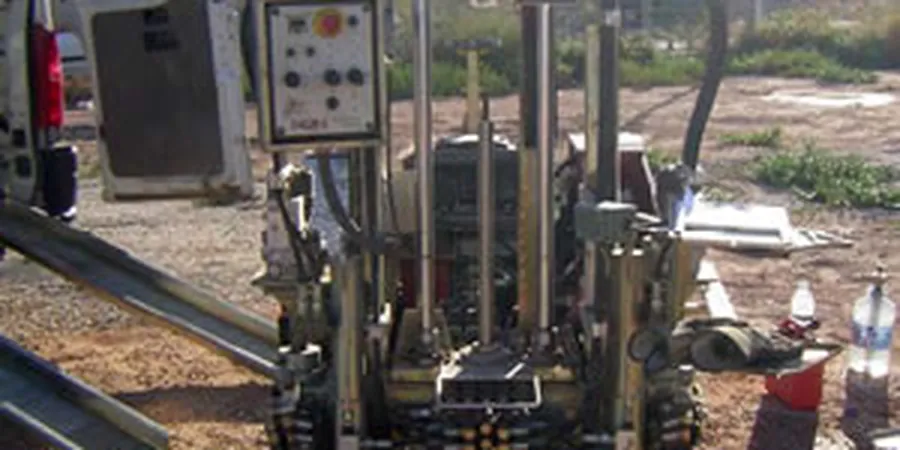
A single CPT sounding to 20 metres in Porirua soils usually takes 60 to 90 minutes of pushing time, plus setup and breakdown. Total site time for two to three soundings is typically half a day. Our tracked CPT rig needs about 2.4 metres of width to access a location, and we can work on slopes up to 25 degrees. For rear-section sites with no vehicle access, we use a portable system that breaks down into components light enough for hand-carrying.