The ground beneath Porirua tells a story of dramatic contrasts. Build near Titahi Bay and you'll encounter dune sands and interbedded estuarine silts that soften fast with depth. Move inland toward Aotea or Whitby, and the profile shifts to weathered greywacke beneath loess-derived clays—competent but riddled with paleochannels where bearing capacity drops abruptly. We've seen two adjacent lots require entirely different pile design approaches: driven steel H-piles for the sandy coastal strip, and large-diameter bored piles socketed into rock for the hillside. With a population approaching 60,000 and the city straddling the active Wellington Fault zone, every pile foundation design we produce in Porirua must reconcile variable geology with seismic demands that few other regions in New Zealand face. The CPT testing data we gather along the harbour fringe often reveals liquefiable layers between 3 and 7 metres deep—exactly where shallow footings would fail during a design-level event. Pairing that data with liquefaction assessment studies allows us to size and reinforce pile elements before the first excavator arrives on site.
A pile is only as reliable as the ground investigation beneath it—skip the boreholes and you're designing blind, especially in Porirua's interbedded harbour sediments.
Approach and scope
Site-specific factors
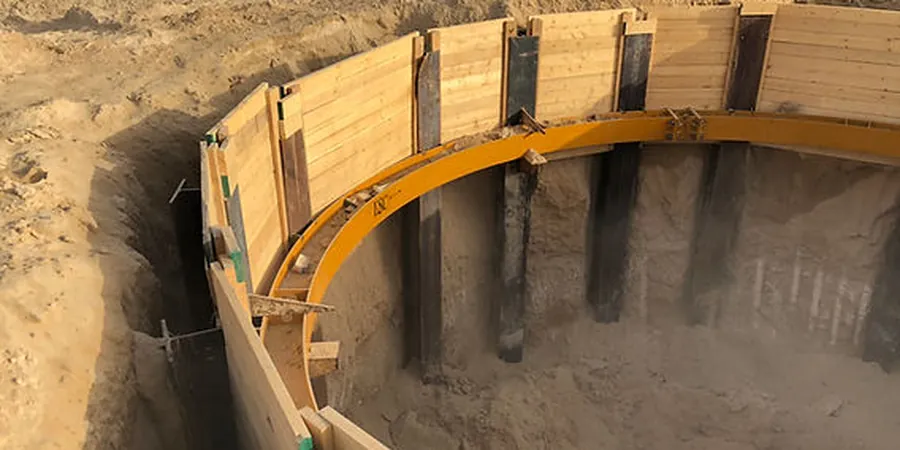
A five-storey apartment complex we reviewed near the Porirua city centre had been designed with uniformly sized driven piles—despite boreholes showing a buried stream channel crossing the northern third of the site. That channel contained soft organic silts with SPT blow counts under 4, and the original design provided zero allowance for the differential settlement that would occur between piles founded in dense alluvium and those terminating in compressible organic material. The contractor halted piling after three piles refused at 22 metres without reaching design bearing. Our redesign introduced a variable-length bored pile scheme with enlarged tips socketed into the underlying greywacke, increasing the pile count by fifteen percent but eliminating the settlement differential entirely. Porirua's combination of buried valleys, shallow groundwater tables, and proximity to the Ohariu Fault makes this type of subsurface surprise common rather than exceptional—the cost of adequate site investigation always underruns the cost of remediation.
Relevant standards
NZS 3404:1997 Steel Structures Standard, NZS 1170.5:2004 Structural design actions – Earthquake actions, NZGS Module 4: Pile Foundation Design Guidelines, AS 2159-2009 Piling – Design and installation
Related technical services
Deep Foundation Design & Peer Review
Full structural and geotechnical design of driven, bored, and CFA pile systems for residential, commercial, and infrastructure projects in Porirua. We specify pile diameters, reinforcement cages, socket lengths into rock, and lateral load resistance parameters using p-y and t-z analyses calibrated to site-specific soil data. Peer review works include independent design checks and value engineering to optimise pile count without compromising factor of safety.
Pile Load Testing & Integrity Assessment
Static load testing to twice the design working load, high-strain dynamic testing (PDA) for driven piles, and low-strain integrity testing (PIT) for bored piles. Our testing programme verifies that installed piles achieve the geotechnical and structural capacities assumed in design. We deliver test reports within 48 hours of completion, allowing contractors to proceed with pile cap construction without delay.
Typical parameters
Questions and answers
What is the typical cost range for a pile foundation design in Porirua?
For a standard residential or small commercial project in Porirua, pile foundation design fees typically range from NZ$3,140 to NZ$11,250 depending on the number of piles, the complexity of the ground profile, and whether load testing supervision is included. Larger multi-storey developments or projects requiring peer review fall at the upper end of that range or beyond.
Which pile type works best in Porirua's coastal soils near Titahi Bay?
Driven steel H-piles generally perform well in the sandy coastal strip because they can be advanced through loose dune sand and into dense alluvium without generating large spoil volumes. However, where liquefiable layers are present—common along the Porirua Harbour edge—bored piles with permanent steel casing deliver better lateral resistance during seismic events, and we often specify them for structures above two storeys.
How deep do piles typically need to go in Porirua?
There is no single answer because Porirua's bedrock depth varies from 4 metres in elevated eastern suburbs to over 18 metres near former stream valleys. Our investigation programme determines the exact refusal depth for each pile location; we design socket lengths of at least three pile diameters into greywacke bedrock where it is reachable, and rely on skin friction in dense alluvium where it is not.
Do you design piles for earthquake loading specific to the Wellington Fault?
Yes. All pile designs we produce for Porirua incorporate seismic actions from NZS 1170.5, which accounts for the proximity of the Wellington and Ohariu faults. We model lateral spreading demands, kinematic soil-pile interaction, and liquefaction-induced downdrag using NZGS Module 4 methods, ensuring piles survive a design-level event without structural failure.
Can you design piles for timber-framed residential houses in Porirua?
Absolutely. Many Porirua hillside homes require piled foundations due to slope instability risk or variable fill thickness. We design small-diameter bored piles with reinforced concrete caps suitable for NZS 3604 timber-framed construction, coordinating with structural engineers to ensure pile layouts align with wall and beam load paths.