Last month we received a call from a contractor working on a subdivision off Warspite Avenue. They had hit a layer of silty clay that looked nothing like the weathered greywacke they expected, and the earthworks spec demanded a full particle size distribution before placing any structural fill. That kind of surprise is common around Porirua—the geology shifts fast between alluvial flats, hill slope colluvium, and reclaimed land near the harbour. A standard sieve analysis gives you the coarse fraction, but when fines pass the 75-micron sieve you need the hydrometer to sort the silt from the clay, and that distinction matters for drainage, frost susceptibility, and compaction behavior. We run both tests together under NZS 4402 and D6913, plus the NZGS soil description guidelines, so the report lands on your desk with a unified classification you can take straight to the council. For jobs where the bearing layer is marginal, we often pair the gradation with a Proctor compaction test to lock in the moisture-density relationship before the roller hits the lift.
A single hydrometer curve tells you more about drainage and shrink-swell potential than a dozen blow counts—if you read it right.
Approach and scope
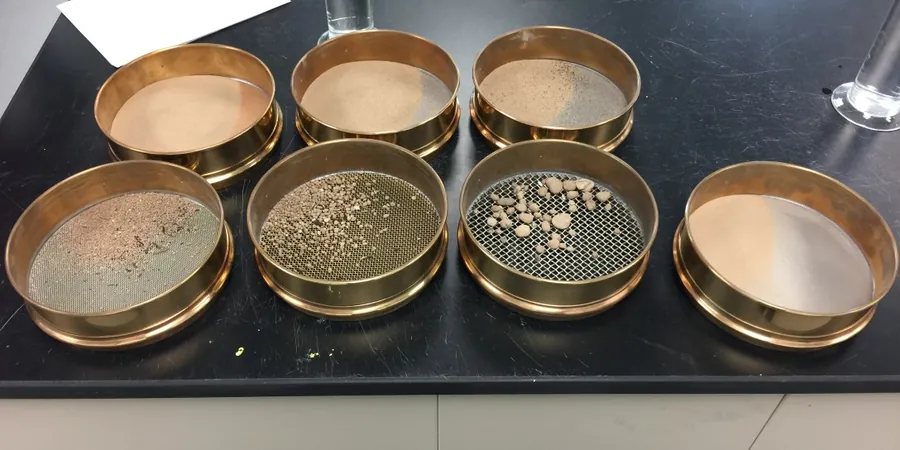
Site-specific factors
One thing we see repeatedly on Porirua sites is a contractor assuming the borrow material is clean sand because it came from a quarry up the hill, then the hydrometer reveals 15% clay fines that turn the subbase into a sponge during the first wet winter. Gap-graded soils are another trap—they compact beautifully on the day but lose strength fast under repeated saturation, and you only catch that pattern when the gradation curve shows a missing mid-range. The real risk is placing concrete aggregate or drainage metal that doesn't meet the NZS 3121 or NZTA M/4 envelope; the council will make you rip it out, and that delay costs more than the lab fee ever would. We also keep an eye on the sand-silt cutoff because Porirua's seismic setting means liquefaction susceptibility is partly graded on fines content, and getting that number wrong has real consequences under the NZGS earthquake engineering module.
Relevant standards
NZS 4402(2007)e2, NZS 4402/D6913M-17, NZS 4402:1986 (Methods of testing soils for civil engineering purposes), NZGS Guideline for the Field Description of Soils and Rocks, USCS per NZS 4402-17e1
Related technical services
Combined Sieve & Hydrometer Package
Wash-through-No.200, full sieve stack, and 24-hour hydrometer sedimentation series. You get a single gradation curve, USCS classification, and a summary table with D-values and coefficients ready for your earthworks or foundation report.
Sieve Analysis Only (Coarse Fraction)
For clean sands and gravels where the fines content is visually negligible. We run the standard sieve stack from 75 mm down to 75 micron, report the gradation envelope, and check conformance against your project spec—often same-day turnaround.
Material Compliance & Quarry QA
Routine gradation checks against NZS 3121 aggregate grading limits, NZTA M/4 drainage metal envelopes, or custom project specifications. We flag out-of-spec material before it leaves the stockpile, saving you rejection at the council inspection.
Typical parameters
Questions and answers
Why do I need a hydrometer test if the soil looks like sand?
Because fines are invisible when they coat sand grains. Even 8% silt or clay can turn a free-draining fill into a water-holding layer that fails the permeability spec. The hydrometer quantifies the silt-versus-clay split, which controls drainage, frost behaviour, and Atterberg limits—critical for Porirua's wet winters and seismic design assumptions.
What sample size do you need for a full particle size distribution?
For minus-20 mm material we need at least 5 kg. If the soil contains cobbles or boulders we require a larger bulk sample—call us with a photo and we will advise. Undisturbed sampling is not necessary for gradation; a representative disturbed bag sample works fine, but it must come from the zone the engineer wants characterised, not the topsoil.
How much does grain size analysis cost in Porirua?
A combined sieve and hydrometer test typically runs between NZ$180 and NZ$320 depending on the number of sieve fractions and whether you need a rush turnaround. A sieve-only analysis for clean granular material sits at the lower end of that range.
How fast can I get the results?
Standard reporting is 48 hours from sample receipt. The hydrometer sedimentation readings require a full 24-hour cycle, so same-day is only possible for sieve-only tests on coarse material. We offer a priority queue for site-critical decisions—let us know when you submit the sample and we will work to your deadline.
Can you do the gradation on concrete aggregate as well?
Absolutely. We run sieve analysis on coarse and fine concrete aggregates per NZS 3121 grading limits and NZS 4402, and we also perform the minus-75-micron wash to check the fines content. If you need the full aggregate package—sieve, sand equivalent, and crushed face count—we can bundle it into a single report for your concrete batch plant or site QA.