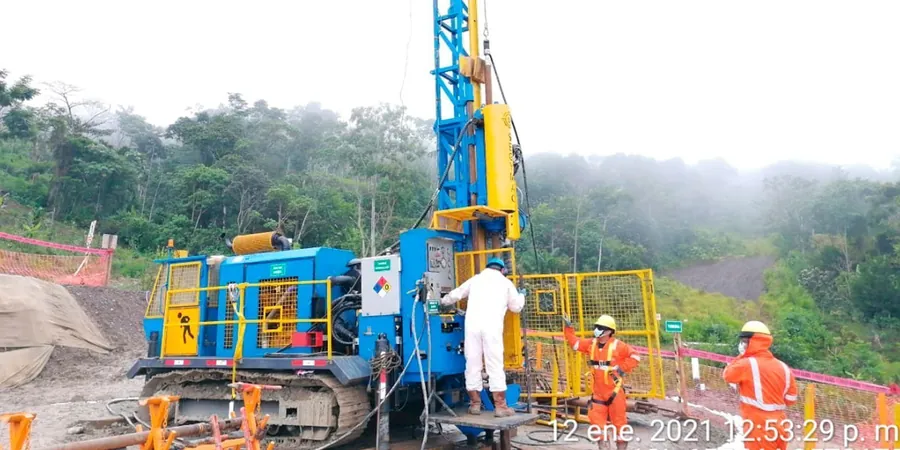
When we pull up to a site in Porirua, the first thing we unload is the double-packer assembly and the calibrated pressure gauge. Running a Lugeon test here is rarely textbook. The fractured greywacke underlying much of the city, particularly around the hillsides of Whitby and Aotea, can accept water in unpredictable ways, and a Lefranc test in the alluvial silts near Porirua Stream needs a careful eye on borehole stability. We set up the water meter, check the constant-head tank, and start recording flow rates every minute. The team works methodically because we know that the permeability values we measure will directly inform dewatering plans and foundation drainage for a project that has to withstand 1200 mm of annual rainfall and occasional seismic shake-ups. Combining this with an SPT drilling program helps us correlate the permeability profile with the actual soil stratigraphy encountered.
A Lugeon value of less than 1 means the rock mass is practically watertight; above 10, you are dealing with open fractures that will take grout easily.
Approach and scope
- Constant-head and falling-head Lefranc tests in overburden
- Lugeon packer testing with five-step pressure stages (EN ISO 22282-3)
- Real-time flow rate logging at 1-minute intervals
- Integration with borehole logs and core recovery data
Site-specific factors
Porirua sits in a high seismic hazard zone (Z=0.40 per NZS 1170.5) and receives over 1200 mm of rain each year. This combination makes groundwater control a safety-critical issue, not a comfort one. If the in-situ permeability assessment underestimates the hydraulic conductivity of a weathered greywacke layer, a retaining wall drainage system designed for the wrong flow rate will clog or bypass, leading to hydrostatic pressure buildup behind the wall. We have seen slope failures in the region triggered by exactly that scenario after a sustained wet winter. A Lefranc test skipped or a Lugeon test run with too few pressure steps can miss a high-permeability fracture set that later causes a blowout during grouting or a flooded excavation. Our job is to spot these features before the digger arrives.
Relevant standards
EN ISO 22282-3:2012, NZGS Guidelines for Geotechnical Investigation, NZS 1170.5:2004 (Seismic)
Related technical services
Lugeon Packer Testing in Rock
Five-step pressure testing using a double-packer system in HQ or NQ boreholes. We measure the water take at each step to characterise fracture aperture and spacing in the greywacke basement.
Lefranc Variable & Constant Head Tests
In-situ permeability measurement in soils and weathered rock, using a slotted standpipe and calibrated water meter. Suitable for alluvial silts, gravels, and residual clays.
Borehole Stability & Casing Management
We coordinate casing advancement and drilling fluid management to maintain a clean test zone, critical in the collapsible silty sands common in the Porirua basin.
Permeability Profiling & Reporting
Combined log of SPT, core recovery, and k-value per depth, delivered with pressure-flow plots and Lugeon values tabulated for direct input into grouting or drainage designs.
Typical parameters
Questions and answers
What is the difference between a Lefranc test and a Lugeon test?
A Lefranc test measures hydraulic conductivity in soil or very weathered rock using an open borehole section. A Lugeon test uses an inflatable packer to isolate a specific interval in rock and applies stepped water pressures to assess fracture conductivity.
How long does a field permeability test take on a Porirua site?
A single Lefranc test can run in 30-60 minutes once the borehole is stable. A full Lugeon test with five pressure steps takes around 90 minutes. Setup and borehole preparation add time depending on the ground conditions.
What does a field permeability test cost in Porirua?
For a Lefranc or Lugeon test as part of a wider investigation programme, the cost typically ranges from NZ$1,010 to NZ$1,630 per test, depending on depth, access, and the number of pressure steps required.
When is a Lugeon test required instead of a Lefranc test?
A Lugeon test is specified when you need to assess the groutability or hydraulic behaviour of fractured rock, for example for dam foundations, tunnel linings, or deep excavations into the greywacke rock beneath Porirua.