The ground beneath a structure in Porirua can shift from dense gravels on the hillslopes of Whitby to soft, compressible silts across the low-lying areas near the harbour inlet. It is a city defined by its geology—situated within a basin filled with alluvial and marine sediments, lying across the active Wellington Fault zone. Shallow foundation design here must reconcile these abrupt transitions. A scheme that works on the weathered greywacke of the western suburbs may fail on the poorly compacted fills that cap old stream channels further east. Our approach integrates site-specific investigation with the in-situ permeability characteristics of the founding stratum, because drainage behaviour directly influences settlement rates under load. We also draw on liquefaction analysis when working near the Porirua Stream corridor, where saturated loose sands can lose strength during a seismic event.
In Porirua’s mixed alluvial environment, the critical check for a shallow foundation is rarely bearing failure—it is differential settlement across the footprint.
Approach and scope
Site-specific factors
Under NZS 3404 and the NZGS Module 6 guidelines, shallow foundations in Porirua demand a thorough seismic assessment that goes beyond a simple bearing capacity calculation. The city’s proximity to the Wellington Fault and the deep basin-edge structure means ground shaking can be amplified in the softer sediments of the city centre and Cannons Creek. Differential settlement triggered by cyclic loading, lateral spreading along the harbour margins, and bearing strength degradation in sensitive silts are all credible failure mechanisms. We have observed sites where a perfectly adequate static design became marginal once the post-cyclic undrained shear strength was factored in. A shallow foundation scheme without a specific liquefaction screening and a settlement-versus-rotation check under the serviceability limit state is incomplete—and is increasingly being picked up during the building consent review by council engineers.
Service video
Relevant standards
NZS 3404: Part 1 – Steel Structures (Seismic provisions for foundation connections), NZS 1170.5:2004 – Earthquake actions, NZS 4404:2010 – Land development and subdivision infrastructure, NZGS / MBIE Module 6 – Earthquake geotechnical engineering practice
Related technical services
Bearing capacity and settlement analysis
We calculate ultimate and allowable bearing pressures under static and seismic load combinations, using site-specific shear strength parameters derived from SPT, CPT, and laboratory triaxial testing. Settlement predictions are modelled for both granular and cohesive profiles, including the effect of adjacent footings.
Seismic performance and liquefaction assessment
We evaluate the risk of liquefaction-induced settlement and lateral spreading for shallow foundations located near the Porirua Stream and harbour edge, applying the NZGS/MBIE Module 6 framework and calibrated CPT-based triggering procedures.
Construction-phase inspection and testing
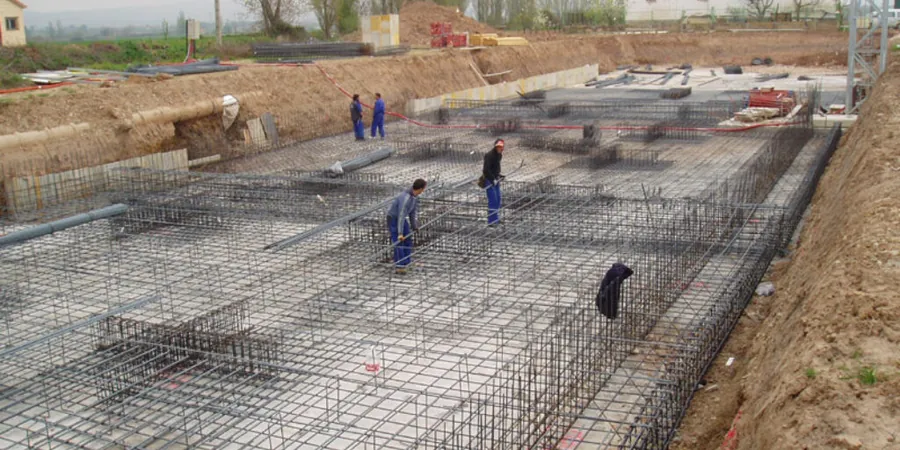
We deliver on-site verification of bearing stratum consistency, compaction testing of engineered fill beneath footings using sand cone density measurement, and inspection of reinforcement placement prior to the concrete pour.
Typical parameters
Questions and answers
How deep do footings need to be in Porirua’s hillside subdivisions?
The minimum embedment depth for strip and pad footings on cohesive soil is typically 450 mm below finished ground level, or deeper if required to reach competent natural ground below fill. On sloping sites in suburbs like Whitby or Aotea, the foundation must also step horizontally to maintain the required depth across the cut-to-fill transition, and the underside of the footing should be founded entirely within the same material stratum where possible.
What is the typical cost range for a shallow foundation geotechnical report in Porirua?
For a residential shallow foundation design package—including a site investigation, bearing capacity and settlement analysis, and a producer statement (PS1)—costs generally range from NZ$2,860 to NZ$5,830 depending on the number of machine-dug test pits or boreholes required and whether liquefaction screening is mandated by the site’s location relative to the stream corridor.
When is a shallow foundation not suitable in this region?
Shallow foundations become impractical when the competent bearing stratum is deeper than 2.0–2.5 m below the proposed underside of footing, or when liquefiable layers are present within the top few metres and cannot be practically removed or improved. We also recommend against shallow footings on uncontrolled fill thicker than 500 mm, or where the site’s slope stability analysis indicates a global factor of safety below the threshold accepted by Porirua City Council.
What council documentation is required for the foundation design?
Porirua City Council typically requires a geotechnical completion report accompanied by a PS1 producer statement for the foundation design, and a PS4 for construction review. If the site falls within a mapped liquefaction hazard area, the report must explicitly address the NZGS/MBIE Module 6 assessment and demonstrate that anticipated settlements are within tolerable limits for the proposed structure.